
Cables & Pulleys: what it involves
Cables carry the whole weight of the boat, and in salt water they wear from the inside out. Strands break where the cable bends over a pulley or wraps the winder shaft, and rust works in where the cable sits wet. A cable can look fine from the dock and still have broken strands hidden in the wrap. That's why most lift makers and techs say to inspect cables at least once a year and to replace them as a set rather than one at a time.
Pulleys, also called sheaves, wear along with the cables. A pulley with a worn groove, a seized bearing or a cracked edge chews up a new cable quickly. A proper cable job replaces every cable on the lift, checks each pulley and swaps any that are worn, sets the wraps so they stack evenly on the shaft, and levels the cradle so the boat rides square.
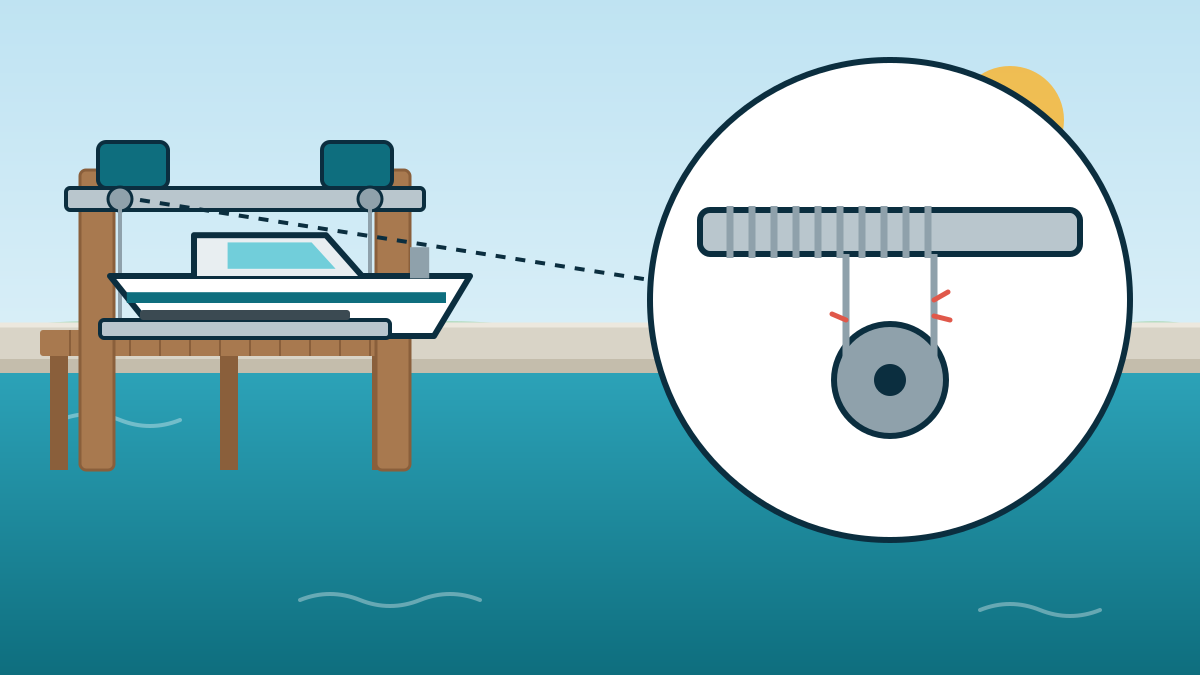
Signs your cables need replacing
- Broken wires or 'whiskers' sticking out of a cable
- Rust or a flattened, kinked section
- Cables stacking unevenly or jumping on the winder
- The cradle hangs lower on one side
- A pulley that wobbles, squeals or doesn't spin freely
See broken strands? Stop using the lift until the cables are replaced.
Free EstimateCommon methods
Full cable sets
All lift cables are replaced together with marine stainless cable sized to the lift, so no old cable is left to fail.
Pulley and sheave service
Each pulley is checked for groove wear, bearing play and cracks, and worn ones are replaced at the same visit.
Wrap setting and leveling
Cables are wrapped evenly on the shaft and the cradle is leveled so both ends lift together.
Do cable replacements need a permit?
No permit is usually needed to replace cables or pulleys on an existing lift. It's maintenance on a structure that's already permitted. A permit comes into play if the lift itself is being replaced, moved or rebuilt, or if pilings and dock framing are being changed. Lee County treats boat lifts as dock and shoreline structures that need building permits when they're built.
- Address
- 1500 Monroe St., Fort Myers, FL 33901
- Phone
- (239) 533-8585
- More
- Lee County dock and shoreline permit guide
Source: Lee County Department of Community Development, checked November 2026.
How a cable job usually goes
- Measure the liftThe tech records the lift type, capacity and cable lengths, or reads them off the old cables.
- Secure the cradleThe cradle is supported so nothing can drop while cables are off.
- Replace the setOld cables come off, worn pulleys are swapped and new cables go on.
- Set the wrapsEach cable is wrapped evenly on the winder so the cradle rises level.
- Test with the boatThe lift is raised and lowered with the boat on it to confirm it runs square.
Ask the tech to show you the old cables. Broken strands inside the wrap are the best argument for replacing on schedule.
What cable replacement costs
Cable jobs are priced by the number and length of cables, the lift's capacity and how many pulleys need replacing. HomeAdvisor's guide puts most lift repairs at about $175 to $500, and a full set of cables and pulleys on a large four-post lift can run higher. See the full cost guide.
Reference figure, not a quote: HomeAdvisor boat dock repair cost guide, checked November 2026.
Cables are cheap compared with a boat that drops into the canal.
Free EstimateWhere cable calls come from most
- Cape CoralBrackish canals that rust cables fast
- Pine Island & MatlachaOpen-water exposure at St. James City
- Fort Myers BeachBack-bay docks with heavy salt spray
- Bonita SpringsImperial River and Estero Bay docks
- Port CharlotteHigh lift counts along the canal network
- Iona & McGregorBusy canal docks near the Caloosahatchee mouth
Related services: Boat Lift Repair, Boat Lift Maintenance & Inspections, New & Replacement Boat Lift Installation.
Cables & Pulleys questions
How often should lift cables be replaced?
There's no single schedule. In salt water, inspect them at least yearly and replace them at the first broken strands, kinks or rust.
Should I replace just the broken cable?
Usually no. The others have the same wear, and mixing old and new cables makes the lift lift unevenly.
Stainless or galvanized?
Most SWFL lifts use stainless cable because it holds up better in salt water. Your tech will match what your lift was built for.